
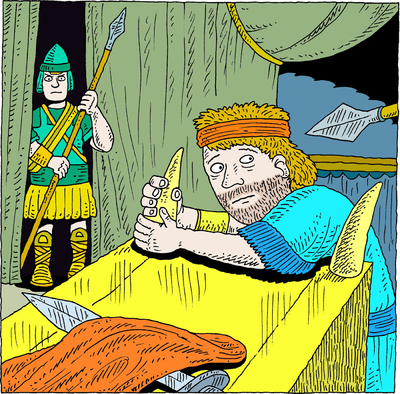
“Adonai will bring his blood back on his own head, because he struck down two men more righteous and better than he — he killed them with the sword without my father David’s awareness: Avner the son of Ner, commander of the army of Isra’el, and ‘Amasa the son of Yeter, commander of the army of Y’hudah. In this way, their blood will return on the head of Yo’av and his descendants forever; but for David, his descendants, his family, and his throne there will be peace forever from Adonai.”-1 Kings 2:32-33
Following on the heels of yesterday’s post, I gotta say, the explanation Solomon gave B’nayah for why it was fine for B’nayah to slay Joab while he was clinging to the horns of the Altar demonstrates a strong understanding of Torah.
An understanding that his father, unfortunately, didn’t possess.
And lemme make it clear, when I say “Torah,” I mean just that homies.
Solomon was not speaking from tradition.
He wasn’t speaking from some barbaric Middle Eastern custom.
His reasoning was based on the pure and undefiled wisdom of God’s Law.
The same law we should all live our lives by, right down to the baconless burgers we may eat from time to time.
Ya feel me?
I should also remind you that the righteous justice Solomon was telling B’nayah to execute is something that should be put into full practice in our nations.
That’s right, homies.
From a Biblical perspective, there ain’t no such thing as justifiable murder.
It simply doesn’t exist.
And to be clear, Scripture does not classify all killing as murder.
There is such a thing as justifiable homicide.
For instance, if some dude is chopping down a tree, and the ax head accidentally flies off and conks someone in the head, causing that person to die.
In that case, a family member has the right to avenge the victim who died.
But if the unlucky ax-chopping dude managed to escape to one of the cities of refuge, he would be protected, and the avenging family member would not be allowed to touch him.
But that’s not what we’re dealing with in Joab’s case.
He was a full-fledged murderer, and murderers are to be put to death.
Period.
Any nation that places murderers in prison instead of properly executing them per God’s Law will have the curse of blood guilt hanging over their communities.
It doesn’t mean diddly squat if the murderer repents of his sin and is sincerely sorry for what he did.
Sure, the Lord will forgive him, and he may go to heaven in the life thereafter.
However, this side of heaven on earth, the Lord demands the life of the murderer as the only just means of atonement.
I hope you homies are feeling me here.
Even if God forgives someone in heaven through faith in Yeshua, that doesn’t mean they escape consequences here on earth.
The reason why is that in this world, serious wrongs bring real judgment upon the whole community.
There’s a lesson there in that the sins you commit in the dark don’t stay in the dark.
They affect freakin’ EVERYBODY!
Why do you think the Lord demands that you cast out the sinner from your community if he remains unrepentant?
Or in the case of a murderer, as I’ve been saying, He demands the death of that person?
Anyway, onward.
So after getting the green light to kill Joab via Solomon’s superb Torah explanation, B’nayah travels back to Gibeon and finds Joab still at the Altar.
Geez, I wonder how this guy ate or took care of his other biological needs, if you know what I mean?
Anyway, B’nayah took out his sword and slew Joab.
Joab died, and his corpse was transported to the family tomb.
Some English Bible translations will say he was buried in the “desert.”
Hmm…I’m not sure how accurate that is.
The original Hebrew is MIDBAR, and that word more accurately means “wilderness.”
And don’t try to get tricky by saying it means “desert wilderness.”
What the heck do you mean by “desert-wilderness?”
It means “wilderness.”
Neither Joab nor his family lived in some cactus-sprouting desert.
He was part of David’s household and hailed from Bethlehem.
The great Jewish sage Rashi says that MIDBAR simply means land that is still unsettled and is only good for grazing animals.
That description would aptly match the area surrounding Bethlehem at this time.
Alright, I know this is getting long, but I got one final takeaway I am compelled to share here.
It is this.
Minus Torah knowledge, B’nayah was confused and uncertain about his next move.
Once he gained the proper Torah knowledge and applied it to his situation, he was able to move forward unhindered and guilt-free.
There’s a lesson there we can begin applying to our lives immediately.
Study God’s Word (not just the New Testament, which ain’t really Scripture anyway) and be DOERS OF THE WORD…not just Cheetos-chomping hearers!
And move forward in life with boldness and confidence!
Ya feel me?
Done.
CONNECTING THIS TEACHING TO THE NEW TESTAMENT
“All Scripture is God-breathed and is
useful for teaching, rebuking, correcting
and training in righteousness,
so that the servant of God
may be thoroughly equipped
for every good work.”
-2 Timothy 3:16-17


Leave a Reply