
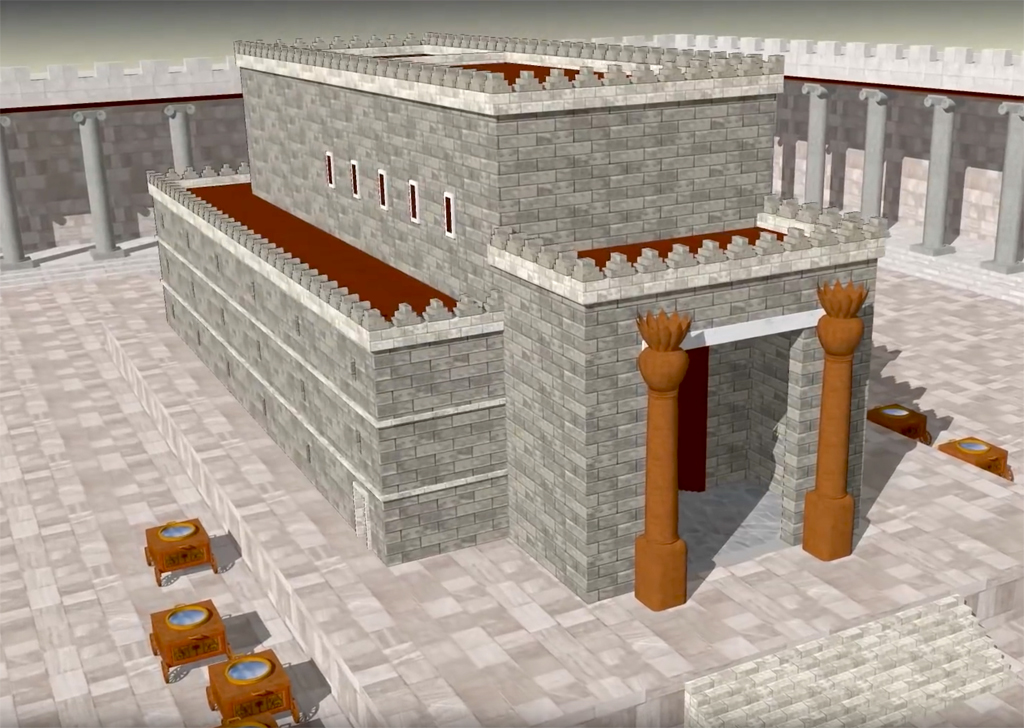
“The foundation of the house of Adonai was laid in the fourth year, in the month of Ziv. In the eleventh year, in the month of Bul, which is the eighth month, all parts of the house were completed exactly as designed. Thus, he was seven years building it.”– 1 Kings 6:37-38
Let’s kick things off with a quick quiz question.
Take a look at verse 33 from 1st Kings Chapter 6 below:
“For the entrance to the temple
he also made doorposts of olive-wood,
set within a rectangular door-frame.”
-1 Kings 6:33
It speaks of the entrance into the Temple building or the HEKAL in Hebrew.
Since the construction of the Temple is patterned after the Tabernacle constructed in the wilderness…
Which part of the original desert structure is the entrance analogous to?
Come on, man, it shouldn’t be that difficult.
The answer is that this is analogous to the entrance leading directly into the Holy Place.
The materials used were also different.
Olive wood was used for the doors between the Holy Place and the Holy of Holies.
However, cedar or fir was used for the main Temple door.
And images of cherubim and palm trees were engraved onto these doors.
We’re told that a courtyard was built right outside the Temple entrance, called the “inner courtyard.”
However, the Mishnah states there were actually two courtyards.
One was the Courtyard of the COHANIM or the “Priests.”
And the other was called the Courtyard of ISRAEL or the “common folks.”
So the “inner court” being mentioned here equals both the Courtyard of the COHANIM and ISRAEL.
But why was it called the inner courtyard?
Well, we need to go to the Mishnah again to find that answer.
In addition to the courtyards of the COHANIM and ISRAEL, the Mishnah says there was another courtyard called the “Courtyard of the Women.”
This was located a bit of a distance outwards.
That’s why the first courtyard was called the “inner courtyard.”
So what takeaway can we extract from all of this?
Honestly, it’s pretty much the same takeaway I came up with yesterday.
The closer one moved toward the presence of God, the more defined and set apart the space became.
There was the outer area, then the inner courtyard, then the Holy Place, and finally the Holy of Holies.
The Temple’s design taught Israel that approaching God was not something to be taken lightly.
We might not have the physical Temple today.
But the principle remains.
God is loving and approachable, but He is also holy.
So the closer we draw to Him, the more we gotta approach Him with reverence, respect, and gratitude.
Ya feeling me here?
Done.
P.S. For those who have no idea what the Mishnah is, it’s the first major written collection of Jewish oral law and traditions. It’s also the foundational text for Rabbinic Judaism and forms the core of the Talmud.


Leave a Reply