
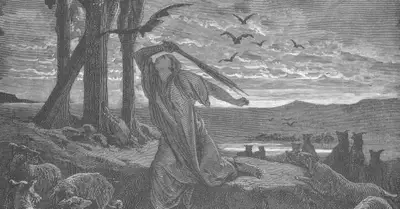
So we’re told that Rizpah, the mother of 2 of the 7 men who were executed, went to the death site where the victims were impaled and set up camp there.
She then covered the ground with a sackcloth, which was a customary sign of mourning.
What was her purpose?
First and foremost, she had to keep birds and other wild beasts of prey, such as hungry jackals, from chomping on the corpses.
Per the Torah, it was not permitted to leave the bodies hanging past nightfall.
But nobody was obeying, didn’t care, or even knew the Torah to follow proper protocol.
The Amorites intended to keep the bodies hanging there indefinitely.
And David, being David at this period of his life, seemed to have cared less.
He just looked the other way.
Another thing we shouldn’t overlook is that in the ancient Middle East, nothing was more disrespectful than to deny the deceased a proper burial.
The general belief is that if the corpse wasn’t properly buried, it wouldn’t be able to enter into the world to come.
But that’s not all we’re told.
Verse 10 says Rizpah remained camped there until the next season of rainfall started.
This would have been from around early April to August.
Why in the world would she do that?
Well, it goes back to the original reason why this whole thing started in the first place.
In response to the 3-year drought, David had asked the Lord why He had closed up the sky in the first place.
And the answer God gave David was due to the curse of bloodguilt hanging over the land due to Saul’s massacring the Gibeonites.
So Rizpah was waiting for the Lord to send rainfall again because in her eyes, that would be the sure sign that He had accepted the execution of the 7 men, including her 2 sons, as a just atonement for the curse now hanging over the land.
Okay, we’ve still got lots to unpack here.
So we’ll continue with this the next time we meet.
But for now, let’s wrap this up with a takeaway.
So they say a mother’s love knows no bounds.
Rizpah couldn’t change what happened.
She couldn’t bring her boys back or undo the injustice.
But she could love them to the very end.
And that’s exactly what she did.
Her character reflects the power of steadfast love.
It doesn’t quit when hope is gone.
It just keeps showing up…
Until God moves again.
Now, here’s what’s interesting.
We know those bodies couldn’t have been an acceptable atonement in the Lord’s eyes.
Why?
Because this whole situation was violating Torah protocol left and right.
Yet, apparently God did eventually lift the curse off the land and send rain.
So the question is, if the execution of the seven men was NOT an acceptable atonement, then what was?
Did the Lord simply decide to show mercy in response to Rizpah’s heartfelt actions and the respect she showed toward her sons and the other men hanging there?
We’ll continue this the next time we meet.


Leave a Reply