
“He would cut his hair only once a year, at the end of the year; and the only reason he cut it then was because it weighed him down. He weighed the hair from his head at 200 shekels (using the royal weight) [about five pounds].“-2 Samuel 14:26
Concerning the voluminous amount of hair on Absalom’s head, some folks surmise he never cut it because, like Samson, he was a Nazarite.
No such thing.
There is less than zero evidence supporting that notion.
Instead, the sages correctly point to Absalom’s narcissistic character as to why he continued to let his hair grow.
It was a sheer act of vanity,
That’s what it came down to.
Now, take a look at where it says his hair weighed 200 shekels.
You might be confused, thinking, “Isn’t a shekel a currency?”
That’s a good question, and the answer is yes.
Today, it’s Israel’s national currency.
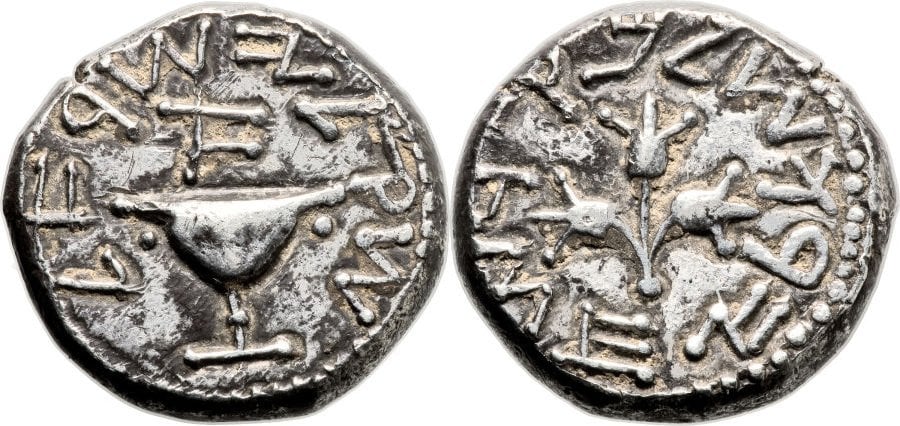
But in the Biblical era, it was a measurement of weight like a pound or a kilogram is in our day.
Metal coins didn’t come onto the scene until much later in history.
It was most likely the Greeks who introduced the coin-based currency system to the Israelites.
But what’s interesting is even when that happened, the value of a shekel was still determined by the coin’s weight.
Either silver or gold was used to create coins.
So, a gold coin was more valuable than a silver coin of the same weight.
Keep in mind, there wasn’t some official agency making sure the scales weren’t rigged in the Middle East back then.
Ya feel me?
Back in the day, every king basically made up his own version of a shekel.
“My kingdom, my rules, homies.”
That was the way things were.
Especially when it came to money.
Even in Israel, there were two different types of shekels.
There was the common shekel that your average citizen used.
And there was the royal shekel for “kingdom-related expenses” like palace upgrades, golden goblets, and all that jazz.
Plus, to make things even more confusing, the value of the shekel fluctuated like a camel on caffeine trying to walk a straight line.
It greatly differed between David’s time and Yeshua’s time.
That’s why your Bible footnotes sometimes sound like they’re guessing.
Depending on which translation you’re reading, it might say something like…
“A talent might be worth this… or maybe that.”
Welcome to ancient economics meets holy confusion.
Alrighty, let’s switch over to the takeaway.
Here’s what’s coming to me today.
We live in a world that overvalues money.
Lemme rephrase that.
We live in a world that freakin’ worships money.
Money has become the standard we use to choose our future mates, occupations, and pretty much everything.
It’s so sickening.
Don’t get me wrong.
I ain’t saying money ain’t important.
It’s very important.
We need it to pay for our rent, groceries, and other necessary expenses.
I’m talking about the worship of money versus understanding that it’s just a tool that enables us to live.
So the next time you read about Absalom’s five-pound hairdo…
Or try to decipher how much a shekel was worth…
Remember, God doesn’t measure value the way we do.
He’s not impressed by our bank accounts…
Our bling…
Or our body count of Instagram likes.
While the world runs after shiny coins and showy crowns…
God’s looking for hearts that fear Him, love truth, and walk humbly.
Absalom’s downfall started with a mirror, not a battlefield.
Let that sink in.
CONNECTING THIS TEACHING TO THE NEW TESTAMENT
“No one can serve two masters.
Either you will hate the one and love the other,
or you will be devoted to the one
and despise the other.
You cannot serve both God and money.”
-Mathew 6:24
“So do not worry, saying,
‘What shall we eat?’
or ‘What shall we drink?’
or ‘What shall we wear?’
For the gentiles run after all these things,
and your heavenly Father knows
that you need them.
But seek first his kingdom
and his righteousness,
and all these things will
be given to you as well.”
-Matthew 6:25-34


Leave a Reply