
We continue our review of the key events leading up to the Book of Kings.
Saul is preparing to battle the Philistines and is filled with dread.
So what does a man do who has abandoned the one and only true God of Israel?
He turns to idolatry, that’s what he does.
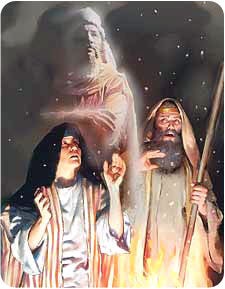
To soothe his anxiety, Saul seeks the services of a witch living in the village of En-Dor.
He has her conjure up the dead spirit of Samuel.
The grumpy ghost comes up and warns Saul that he and his sons will be killed in the upcoming battle with the Philistines.
While this was happening, David and his men went to war against and utterly destroyed the Amalekites.
Unfortunately, things wouldn’t fare as well for Saul.
As the apparition predicted, he and all of his sons, including Jonathan, end up dying on the battlefield.
Saul, in particular, met a most gruesome end.
Severely wounded, he asked his armor-bearer to kill him.
But the armor-bearer, being a young boy, couldn’t bring himself to kill the king
So Saul took his own life by falling on his sword.
This marked the death of the first king of Israel.
The way was now cleared for David to assume the throne of Israel.
So what’s today’s takeaway?
Essentially, we are presented with two models of a royal monarchy ruling Israel.
One model shows what happens when the throne is ruled by a king driven by ego and selfish human desires.
The other model shows what happens when a king submits to and obeys the desires of His master in heaven.
Finally, I find it interesting that Saul dies at the hands of Israel’s sworn enemies, the Philistines, while David destroys the very people Saul was commanded to wipe out but failed to: the Amalekites.
As I said before, Saul’s rulership represents the anti-King or anti-Christ, whereas David represents the Messiah.
I believe we will see this pattern play out again in the future.
Done.


Leave a Reply